
Your Registration Week
6 lessons, 4 accounts, and 0 dollars on one of the two routes through them. That is the whole course, and the only part left is the order.
Order matters here for one mechanical reason. Two of the four accounts want numbers that only exist once an earlier account has issued them, so doing this out of sequence produces registrations that stall.
Affiliate first, register works second. Every writer needs an IPI before a song code can be issued, and the affiliation is what issues the IPI.
So this lesson fixes the sequence, runs three situations past you, prices the whole set, and leaves you with a card you can work through in an afternoon.
The order the accounts open in
Six moves, and the first one unlocks the two that follow it. Read them as a queue rather than a menu.
Which account pays the writer half of performance money?
Your performing rights organisation, from the moment you affiliate as a writer.
Which one pays the publisher half?
The same organisation again, once a publishing entity in your own name is affiliated alongside you.
Which one pays mechanicals on US streaming?
The MLC, free, joined as a self-administered songwriter.
Which one pays for non-interactive radio plays of the recording?
SoundExchange, with featured artist and rights owner both ticked on one account.
Affiliate as writer and publisher together, collect both IPI numbers, register each work with its recording code attached, open The MLC, open SoundExchange in both roles, and file every signed split sheet somewhere you can reach from a phone.
Check yourself
Nothing below is recorded, counted or gated. Answer them the way you would answer a co-writer who asked you over a table.
You register three works at your PRO on Monday and affiliate on Friday. What happens to Monday's registrations?
They complete and backdate once the affiliation lands
They stall, because no writer on them has an IPI yet
They are rejected and have to be typed again from scratch
Affiliation issues the IPI, the IPI identifies the writer, and a song code is only assigned once every writer on the work is identified. Friday's work has to come before Monday's.
Your distributor's dashboard shows a year of earnings. Which of the four pots is it showing you?
All four, netted down to one figure
The recording share from the shops it delivers to
The recording and the mechanical, but not performance
Plain distribution moves your recording money and nothing else. DistroKid says so in its own help centre, and a distributor's publishing product is a separate purchase with a commission on it.
A track has been on internet radio for four years and you have never registered anywhere. What is unrecoverable?
The mechanical royalties from the first year
The writer share of performance money
The non-interactive royalties older than three years
Mechanical and performance money waits. Non-interactive money on the recording expires under 37 CFR 380.44, which is why SoundExchange sits early in the queue rather than last.
What the whole set costs
Add the cash column up before you decide anything is expensive. On one route the total is zero.
Whatever is still shut is holding money, and every code this system routes on comes free with the affiliation. Two lines below carry a fee, and one of the two is optional.
Writer and publisher together at ASCAP: nothing, in a single application.
Writer at BMI plus a publishing entity there: free as a writer, a one-time fee for the entity, no annual dues afterwards.
The MLC, joined with no publishing company behind you: nothing, one account.
SoundExchange with both roles ticked: nothing, one account.
Your own ISRC registrant prefix: $95 one time, or free codes from your distributor instead.
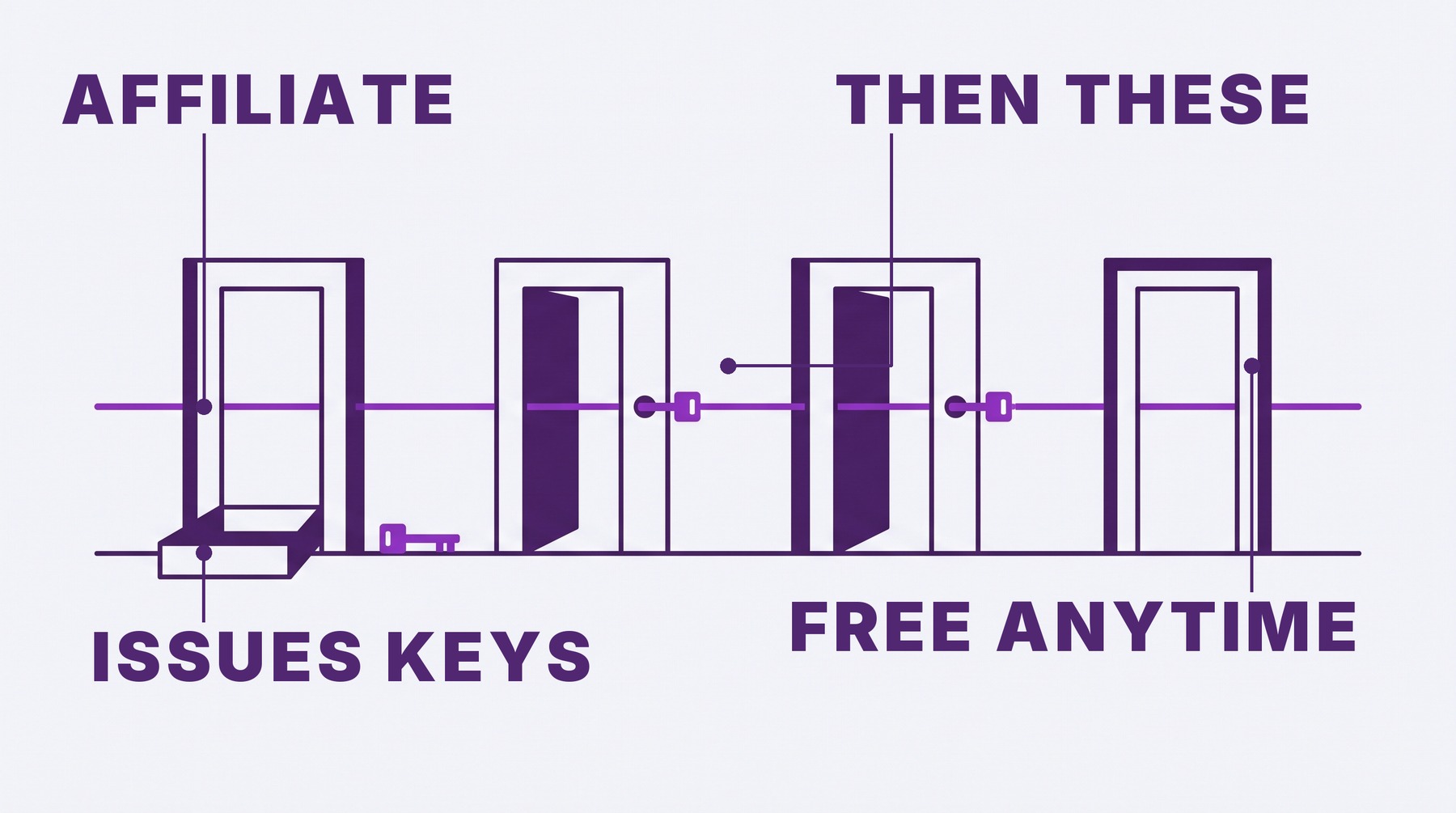
Four doors in a queue. The first one hands you the numbers the second and third will ask for, which is why the order in the picture is the order to work in.
Your week, in one card
Six lines, done properly, in the order printed. An afternoon covers most of it, and the back catalogue claim is the part that takes an evening.
Apply as writer and publisher in one application, with three name options
Record both IPI numbers where you can find them again
Register every released work, recording code included
Open The MLC as a self-administered songwriter
Open SoundExchange in both roles and run Search and Claim
Sign a split sheet for every co-write and file it
Five of those six are forms. The sixth is a habit, and it is the one that decides whether the other five keep working two years from now.
What you leave with
Finish all six lessons and this academy issues a certificate of completion, carrying your name, and a page where anyone can check it. Reading anonymously records nothing at all, and a free account is what collects it.
The one account you will open first
Name it, and name the release you will register through it once it is open.
Nobody in this system sends a reminder. Four logins is the difference between a catalogue that pays once and a catalogue that pays four times.
Open the joint writer and publisher application before you close this page.
Where these numbers come from
The fee lines are taken from ascap.com and bmi.com's own joining pages and from usisrc.org, checked September 2026. Figures are as those pages read in September 2026. The distributor answer follows DistroKid's own help centre article on PRO registration. The three year expiry is 37 CFR 380.44. The dollar figures on the panel come from the worked example in lesson one, where two inputs are labelled estimates. No result here is measured from any artist's account.