
One Song, Four Pots
Your distributor pays you out of one pot. There are four, and the other three open only when you go and open them yourself.
Your dashboard is honest about what it holds. It shows what the shops your distributor delivers to sent back for the recording, and nothing arrives to tell you about the rest.
One recorded song is two separate properties, and a writer who releases their own work is owed money on both of them in four capacities at once.
So this lesson takes a single release apart into the four pots it fills, names the organisation sitting behind each one, and hands you a sentence that shows in ten seconds which of them are paying you.
The song and the recording
Write a song, record it, and you have made two things that copyright treats as separate property. The composition is the melody, the lyric, the structure. The recording is the one specific take that went up to the shops.
A label deal usually takes the recording and often a piece of the song as well. Write your own material, pay for your own session, put it out under your own name, and both halves belong to you all the way through.
Two copyrights, four capacities. Writer and publisher on the song. Featured artist and rights owner on the recording.
Four capacities means four registrations at four organisations, and no one of them registers the members of any other. There is no central desk. Nobody is employed to notice that you are missing from a database.
Four pots, four front doors
Every capacity sits behind one organisation, and each organisation wants something different from you before it releases anything.
The writer share of performance royalties on the song, held by a performing rights organisation such as ASCAP or BMI.
The publisher share of that same performance royalty, which needs a second affiliation at the same organisation, in a publishing name of your own.
Mechanical royalties on the song from US streaming, held by The MLC, which charges its members nothing.
Digital performance royalties on the recording from non-interactive radio, held by SoundExchange, which wants you in two roles on one account.
Read those as four front doors rather than four line items. Your distributor walks through the first one on your behalf and never touches the other three.
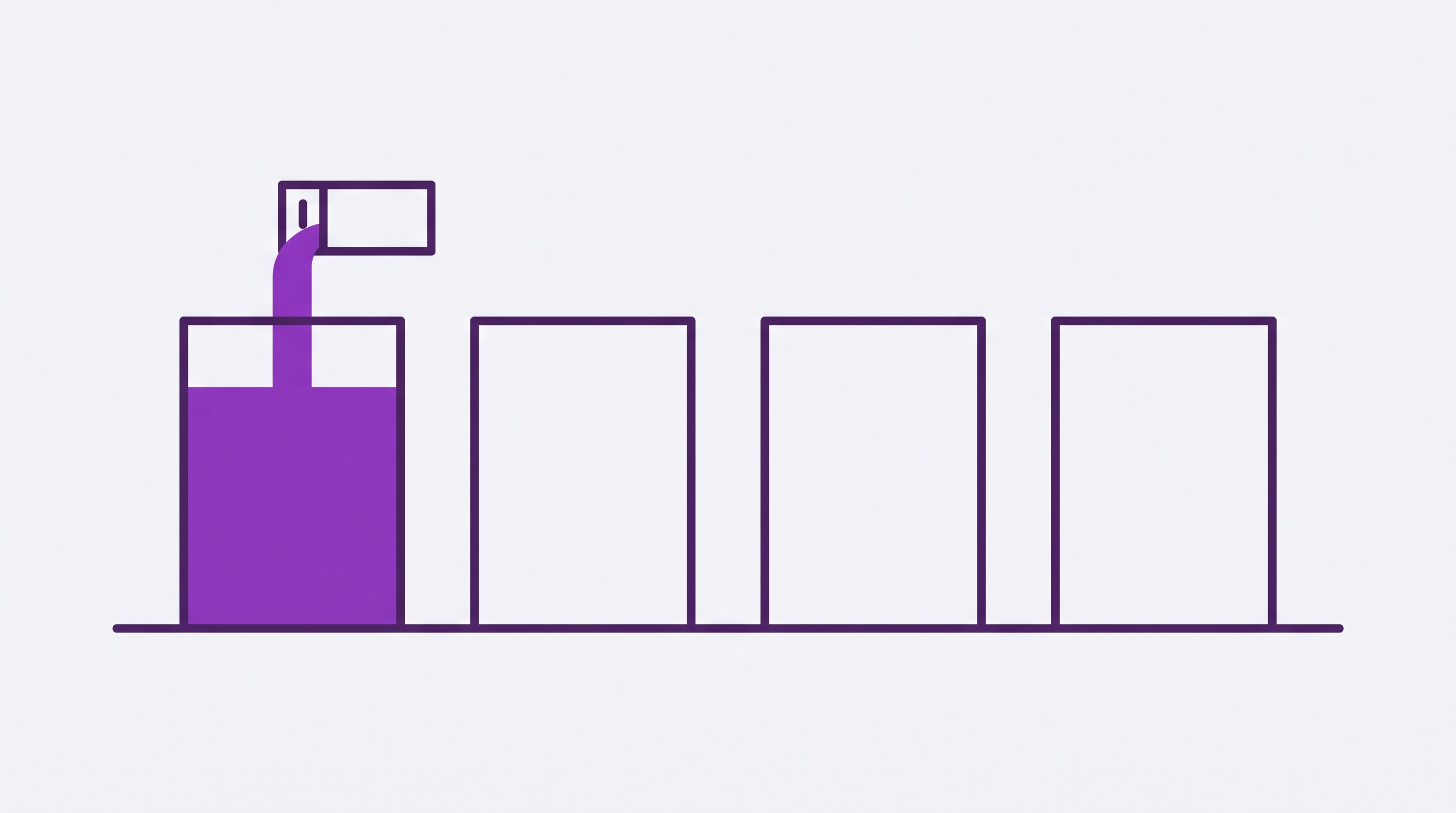
One song, four containers, one of them filling. The other three take the same money at the same moment, into accounts that will not exist until somebody opens them.
What a quarter of a million streams pays
Spotify publishes a figure worth doing arithmetic on. Artists who accounted for 1 in every 1 million streams generated over $11,000 on average across 2025, so 250,000 plays in a year is roughly $2,750 of rightsholder money.
That $2,750 divides by copyright before a cent moves. Around $2,145 belongs to the recording and comes home through your distributor, because that is what a distributor is for. The remaining $605 belongs to the song.
Inside the song side, roughly half is performance money a performing rights organisation collects and roughly half is mechanical money The MLC collects. The performance half then divides again, into a writer share and a publisher share worth about $151 apiece.
So the song side of one modest year is three amounts, around $151, $151 and $303, sitting at two organisations. None of the three is large on its own. All three are gone if nobody claims them.
About $605 of a $2,750 year waits behind three accounts, and every one of the three has to be opened by the writer.
Move the panel below to a year you recognise, then watch which pots stay shut.
Left on distributor only, the panel collects the recording and halts. Adding the writer affiliation opens one pot. Adding a publisher entity and The MLC on top of it closes the gap entirely.
Two of the figures behind that arithmetic are estimates, and the panel says so on its own reading line. Nobody publishes the share of service revenue that reaches rightsholders, and nobody publishes how the song side divides between performance and mechanical money.
Where the fourth pot stays empty
Those 250,000 streams generate no SoundExchange money whatsoever. On-demand listening sits outside the statutory licence SoundExchange administers, so the fourth pot fills only from internet radio, satellite radio and similar non-interactive services. A release nobody has played on that kind of station has three live pots today rather than four. Register anyway, because the account costs nothing and the plays turn up without warning.
The sentence to say out loud
Take your most-streamed release and say this about it, slowly enough that the gaps show themselves.
Any capacity you cannot log into is a pot with your money in it and your name nowhere on the paperwork. Four logins is the whole target, and everything that follows here is how you collect them.
Where these numbers come from
The $11,000 per million streams is Spotify's own published figure at loudandclear.byspotify.com, checked September 2026. The 2026 statutory mechanical pool of 15.3 per cent of service revenue comes from the Copyright Royalty Board's Phonorecords IV determination. Two figures in the split are estimates and are labelled as such on the panel: the share of service revenue reaching rightsholders, and the performance to mechanical division inside the song side. Neither is published by any service. Nothing here is a measured result about any artist, label or tool.