
The Publisher Half
The statement looks complete. Half of everything that song earned in performance royalties is sitting somewhere else, and nothing on the account has the standing to ask for it.
That half has a name. Performance money on a composition arrives in two equal halves, one owed to the writer and one owed to the publisher, and affiliating as a writer claims exactly one of them.
BMI states it plainly. The total writers' shares are 100 per cent, and the total publishers' shares are the remaining 100 per cent.
So this lesson shows where the second half goes, what it takes to be entitled to it, and the two mistakes that break the chain between a writer and a publishing name.
One royalty, two halves
ASCAP states the same structure with different arithmetic. Writer splits on a work add up to 50 per cent, publisher splits add up to 50 per cent, and the two together make the whole.
Same shape, different notation. Whichever organisation you join, a performance royalty leaves the licensee as one amount and lands as two, and each of the two needs somebody registered to receive it.
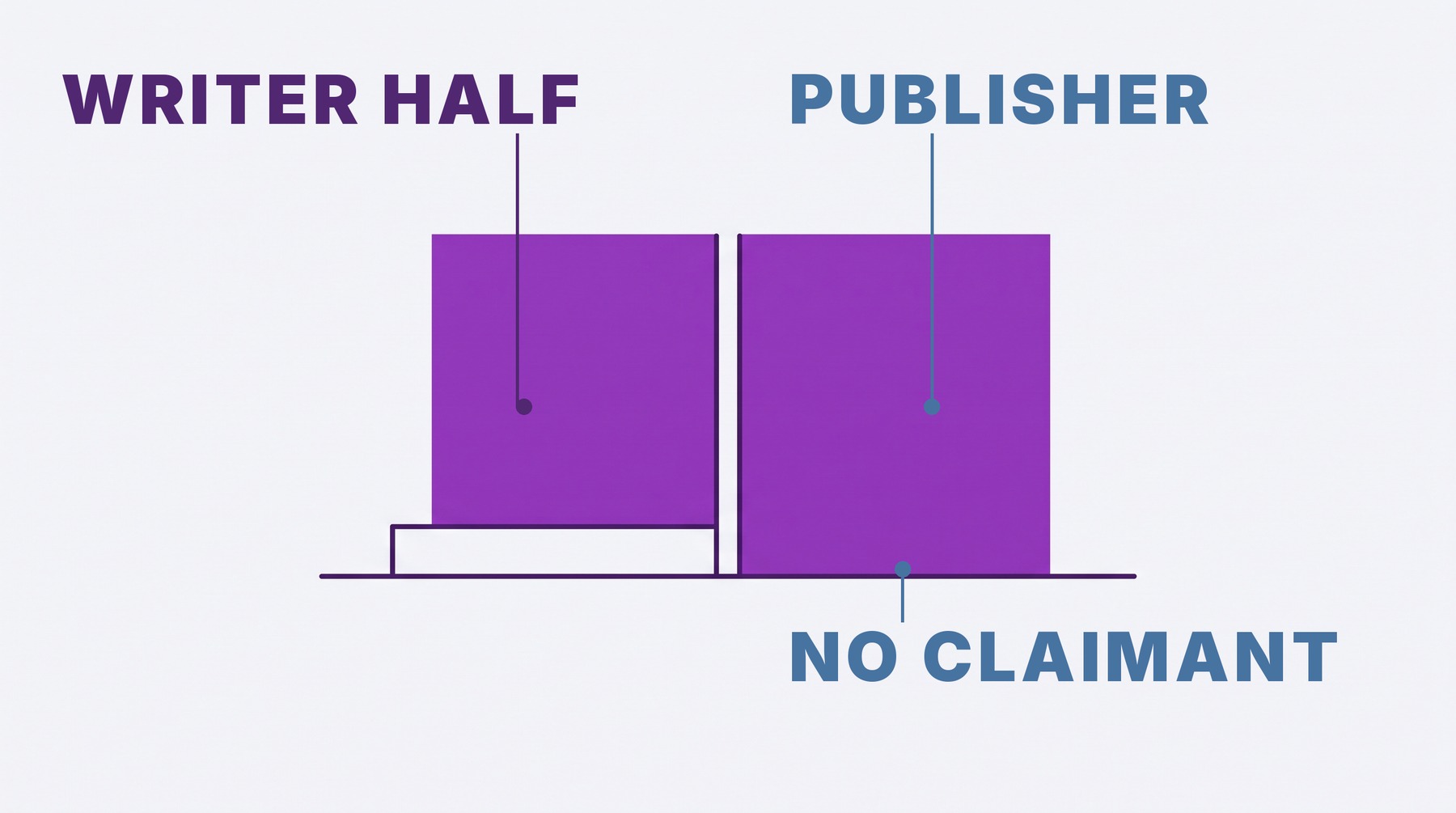
Both halves are the same size. The one on the left has a claimant the moment you affiliate as a writer, and the one on the right waits for a publishing name that most writers never create.
Why the second half waits
Nobody is holding your publisher share back. There is simply no entity registered against it, and the money is not redirected to the writer by default because the writer is not who that share belongs to.
Songwriters hear the word publisher and picture a deal. In this context it means an affiliation you open yourself, under a name you choose, with you as the only person in it.
Take any performance royalty you have already been paid and halve it. What arrived was the writer share, and the other half is the subject of this whole lesson.
Nothing about the writer half changes when an entity exists alongside you. What changes is whether the second half has a claimant, and that is the entire difference one extra form makes.
Joining as both at once
ASCAP and BMI both operate under consent decrees with the US Department of Justice, which means they have to accept applicants who qualify. The other two US organisations are invitation only, so an independent writer has two real options.
Both halves of every performance royalty have a claimant
ASCAP waives both application fees on one joint application
Your own publishing name on every work registration
Half of the performance money accrues with nobody to pay
The ASCAP publisher fee applies when you go back for it
Works already registered need reworking to add the entity
At ASCAP the writer membership is free and applying as a publisher on its own carries a one-time processing fee, and both fees are waived when the two are taken in a single application. At BMI the songwriter affiliation is free and setting up a publishing company carries a one-time fee, with no annual dues after it.
Neither organisation asks for a company. An individually owned publishing affiliation exists at both, and no lawyer has to be involved in creating one.
Naming the entity
BMI refuses any publishing name identical or similar to one an established company already holds, which is why applications ask for choices in order of preference.
Order them by preference and keep them plain. Special characters cause trouble, and a single submitted name is how an application stalls for weeks.
An ASCAP writer needs an ASCAP publisher. A BMI writer needs a BMI publisher. Split them across two organisations and the chain breaks in the middle.
Acceptance produces an IPI number for you as a writer and a second one for the entity. Both are free, both arrive automatically, and both go on every work you register from that day.
Three or four names costs nothing to prepare and saves a resubmission. The same holds for the second step, which is the mistake that survives longest because everything looks correct until a payment fails to arrive.
What this half does not cover
Your affiliation covers performance royalties on compositions. That is its whole remit, and the boundary matters more than any fee on this page.
It does not collect mechanical royalties, it does not collect anything owed on your recording, and it has no reach into the money a non-interactive station generates. Those live in the two lessons ahead of this one, behind two more accounts.
Where these numbers come from
The 100 plus 100 structure is quoted from bmi.com's Royalty Policy Manual and the 50 plus 50 notation from ascap.com's own registration guidance, both checked September 2026. The consent decree position on which organisations must accept qualifying applicants comes from a Congressional Research Service brief. Fee wording is taken from each organisation's published joining pages as they read in September 2026. The dollar amounts on the panel are yours, not ours.